Software 3.0 Explained: Why We Need to Rethink User Interfaces
- Ankit Choudhary
- July 15, 2026

Software 3.0 is forcing us to rethink interfaces, workflows, and the systems we built around humans being present in every operational loop.
Software has always sat between what a person wants and what a machine can do. For most of computing history, that meant a human sat at the centre of every operation, translating intent into workflows, workflows into software actions, and software outputs back into decisions. We were the coordination layer; not by choice, but by necessity, because the systems themselves could not reason, adapt, or communicate with each other on their own.
Software 3.0 describes a new way of building software where users express intent instead of executing workflows. Rather than navigating menus and forms, intelligent systems understand goals, determine execution paths, and coordinate actions across applications. Intent, here, is simple: it is the outcome a person wants, independent of how it gets done. “Get me to the airport before 7 PM” is intent. Choosing a ride type, a payment method, and a booking flow are implementation details, the parts a person used to have to handle themselves.
That assumption shaped almost every application we use today. Software exposed workflows because humans were expected to drive them step by step. Interfaces revealed implementation details because systems could not infer intent reliably. Users learned which tool to open, where to click, what sequence to follow, and how to manually coordinate between systems that had no understanding of each other.
Software is no longer built around humans operating workflows. It is increasingly built around machines understanding intent.
That is the more interesting story here; not Software 3.0 as a technology, but what happens to the interface once the old assumption stops holding. For the first time in fifty years, software is beginning to adapt to human intent instead of forcing humans to adapt to software.
From Software 1.0 to Software 3.0
Modern computing evolved in roughly three phases, each shifting how much translation work humans had to perform. In Software 1.0, humans wrote explicit instructions, and code itself was the program. In Software 2.0, models learned patterns from data; instead of manually encoding every rule, we trained systems statistically. Software 3.0 shifts the abstraction again. Humans increasingly specify outcomes, constraints, and preferences, while systems determine execution paths dynamically.
As Andrej Karpathy describes it, Software 3.0 is not just software with AI features bolted on. It is a different way of programming computers altogether, where natural language becomes part of the programming interface. That framing matters because it changes what software actually operates on. Traditional software operated on explicit instructions. Modern systems increasingly operate on goals, context, and intent.
This is possible now because large language models can interpret open-ended goals in a way earlier software couldn’t, and the agent architectures built around them; planning loops, memory, tool use let that interpretation turn into multi-step action. Earlier systems could classify or predict. Modern agents can interpret a goal, choose actions, recover from failures, and coordinate across systems, which is what makes intent a practical interface rather than an aspirational one.
In earlier generations, we still carried most of the burden. We knew what we wanted, but we had to express it in forms the machine could execute: code, forms, menus, workflows, APIs, dashboards. Our mental model had to align with the software’s mental model. Software no longer only executes instructions. Increasingly, it interprets intent.
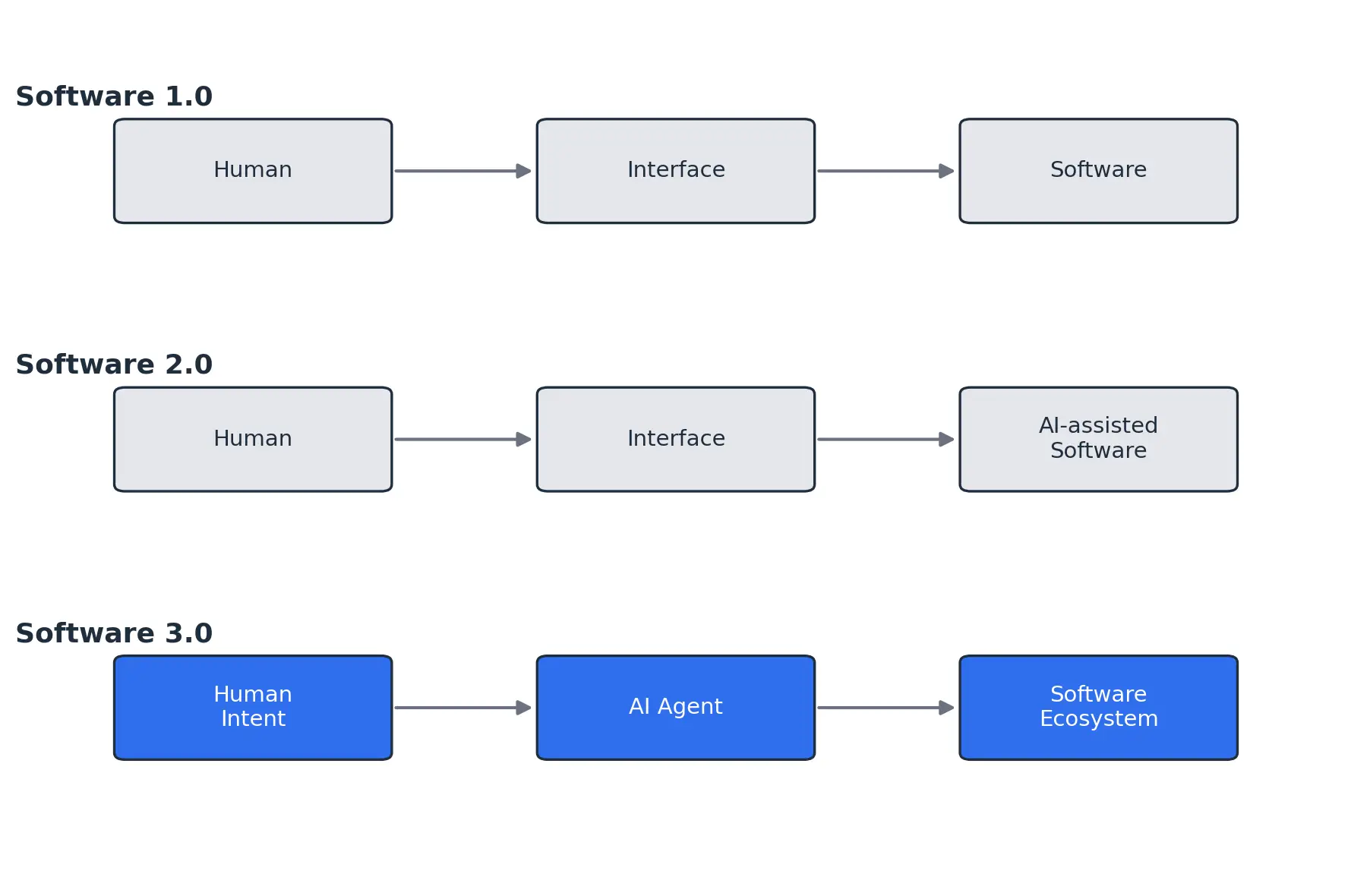
Each phase moves more of the translation work from the human to the system.
Humans Became Middleware
Almost every workflow system, enterprise application, dashboard, or approval process ever built shares one underlying assumption: a human sits in the middle. The human resolves ambiguity, decides what happens next, copies information between systems, interprets edge cases, and coordinates workflows that software cannot coordinate on its own. This was not a bad design. It was a reasonable response to real technological limitations.
When we look closely at how knowledge work actually gets done, a significant portion of it turns out to be operational translation: copying data between tools, turning business intent into software actions, switching context across fragmented systems, triggering workflows manually, and handling exceptions that software was never designed to manage. In many ways, humans became middleware embedded inside organisational software stacks; not because that was the right design, but because the systems had no other way to fill the gap.
Consider something as ordinary as booking a cab. We open an app, enter pickup and drop locations, compare prices, select a vehicle, choose a payment method, retry because surge pricing changed, and maybe coordinate timing with our calendar. At every step, we are acting as the orchestration layer between systems and workflows. But the actual intent is far simpler: get me to the airport by 7 PM, cheaply if possible. Everything else is overhead imposed by the interface itself.
Higher Stakes: Prior Authorization
Cab-booking shows this shift at its easiest. Prior authorization shows where the stakes are real; it’s the approval a doctor needs from an insurer before a patient can get an expensive treatment, and it puts the same kind of manual translation work on a doctor that cab-booking puts on a rider. Today, a doctor’s staff must learn one insurer’s portal, then another’s, each with different forms and rules. The decision itself takes seconds. Turning it into paperwork three different systems will take hours, while the patient waits. Now change the interface. The doctor simply states what the patient needs and why. An agent takes it from there: it gathers the evidence, checks it against the plan’s rules, files the request, and tracks it until it’s approved. The doctor no longer operates the portal; the agent does. But the decision still belongs to the doctor. The agent prepares the case; a person still signs off, because a mistake here affects patient safety, not just a screen.
We weren’t using software. We were translating for it.
Software 3.0 starts shifting that burden. Instead of manually orchestrating each step, users specify goals and constraints while systems determine execution paths dynamically and ask for clarification only when genuinely necessary. The important shift is not that cab-booking or prior-authorization becomes automated. It is that humans stop having to manually coordinate software systems themselves.
Case Study: Qualcomm Is Betting on the Same Future
This shift is no longer confined to argument. In June 2026, Qualcomm’s CEO, Cristiano Amon, told CNBC that the company is currently developing more than forty device designs: smart glasses, camera-equipped earbuds, rings, pendants, pins, etc. are built around a single underlying principle: a device that stays with the user, observes the surrounding environment, and hands off tasks to an agent. His view was direct: apps are “not dead,” he said, “but apps are going to change”, agents are becoming the new application layer. Ask about a transaction, and the agent retrieves it directly, without the user opening a banking application or navigating its menu structure.
This is the cab-booking example again, expressed as a hardware roadmap rather than an argument. Amon expects smart glasses shipments to move from tens of millions of units a year to several hundred million within a few years, approaching the scale smartphones reached in 2025. Whether that particular timeline holds is a separate question. What the announcement confirms is the direction: the industry building the physical devices is making the same wager this piece is making that phones do not vanish, but their primacy does, once something else can act on a person’s behalf.
Every Computing Revolution Changed the Interface
Every major computing transition has also been an interface transition. Early computers required punch cards and assembly language. Later came command-line interfaces, then graphical interfaces that made computing accessible to far larger groups of people. Mobile computing reduced interaction further through touch and simpler models. Each transition reduced the amount of machine-specific fluency humans needed. But across all of these eras, one thing remained constant: humans still adapted themselves to the machine.
Software 2.0 improved machine perception dramatically; through recommendation systems, translation models, ranking systems, speech recognition, etc. But the interaction model itself remained largely intact. Software 3.0 changes the interaction layer directly. The system no longer waits for explicit step-by-step instructions. It increasingly operates on goals, constraints, and context instead.
Every one of those earlier revolutions also expanded who could use computers. Graphical interfaces took computing beyond programmers. Touchscreens brought billions of people online. Intent-driven interfaces may do something even more profound: they may remove the need to learn software in the first place. When we no longer have to understand an application’s workflow to accomplish a task, software becomes less about operating tools and more about expressing goals.
That covers what changes for the people still using software directly. The stranger part of this shift is what happens once the primary users of software stop being people at all, which is where this argument goes next, in Part 2.
Written by: Ankit Choudhary | [Website] · [LinkedIn]
Frequently Asked Questions
Software 3.0 describes a new way of building software where users express intent and constraints instead of executing workflows. Instead of navigating menus and forms, systems interpret goals and coordinate the necessary actions on their own.
The name follows the progression of how software has been built. Software 1.0 was written as explicit code. Software 2.0 replaced hand-written rules with models trained on data. Software 3.0, a term popularised by Andrej Karpathy, describes systems where natural language and intent become part of the programming interface itself, rather than an app or workflow bolted on top.
Software 2.0 trained models to recognise patterns in data, but people still had to frame the problem and operate the interface around it. Software 3.0 removes that translation step: people describe outcomes, and the system determines how to get there.
Not necessarily. What changes is how much of an application a person has to operate directly. Interfaces built around intent still rely on applications, APIs, and data underneath. They just stop requiring a human to manually coordinate between them.
Intent-driven interfaces let a person state a goal and its constraints rather than a sequence of steps. The system interprets that goal, decides which tools or workflows to use, and asks for clarification only when genuinely necessary.