Breaking Free from Low-Code Lock-In with AI-Driven Modernization
- Varun Ramanathan
- April 3, 2026
There’s a liability that never appears on balance sheets: the slow realization that the platform you chose for speed is now the thing slowing you down.
Low-code and no-code platforms deliver on their promise but only initially. Organizations that have lived with these platforms for several years know the other side of that bargain. Product roadmaps outpace what the vendor can accommodate. Integration requirements balloon beyond what was ever anticipated. And the business logic that once fit neatly into drag-and-drop workflows now strains against every constraint the platform imposes.
If you’ve built on platforms like OutSystems, you’ve likely felt the gap between what tools like Service Studio make easy and what your architecture actually needs; especially as you evaluate paths like ODC. If you’re on Mendix, you know the runtime licensing model becomes increasingly difficult to sustain as you scale beyond departmental use cases. These aren’t platform failures; they’re the natural consequence of organizations evolving faster than any vendor’s roadmap can follow.
The result is a familiar bind: your software works, but it can’t grow. You traded long-term flexibility for short-term velocity, and the bill has come due.
This article is the first in a series exploring that shift, and how AI is changing the path forward.
The Economics of Staying Put
Migration out of LC/NC platforms has historically been brutal. Large upfront investment with uncertain timelines. Senior engineers diverted from product innovation. Little visible business value until the migration is complete. Testing that resembles archaeology, rediscovering behavior that was never formally documented.
With 80% of U.S. businesses now using low-code tools and the market projected to reach $65 billion by 2027, the sunk cost fallacy runs deep. Teams postpone and work around limitations. They build adjacent systems that compensate for what the platform can’t do. And the complexity compounds until an external forcing function (a vendor sunset, a compliance deadline, a strategic acquisition) makes the status quo untenable.
Modernization becomes something you do only when the alternative is worse. For executives tracking engineering spend against output, this pattern is painfully familiar: capital tied up in maintenance, not momentum.
AI Is Rewriting That Calculus
On December 26, 2025, Andrej Karpathy, former AI director at Tesla and OpenAI co-founder, posted a reflection that captured what many in the industry had been sensing: “I’ve never felt this much behind as a programmer. The profession is being dramatically refactored as the bits contributed by the programmer are increasingly sparse.” His post drew over 14 million views in days.
But Karpathy wasn’t lamenting. He was signaling a phase change. Tools like Claude Code, Cursor, and Windsurf are demonstrating that AI-assisted engineering can be both fast and reliable at scale. “Vibe coding,” a term Karpathy coined earlier in 2025, has since been named Collins Dictionary’s Word of the Year.
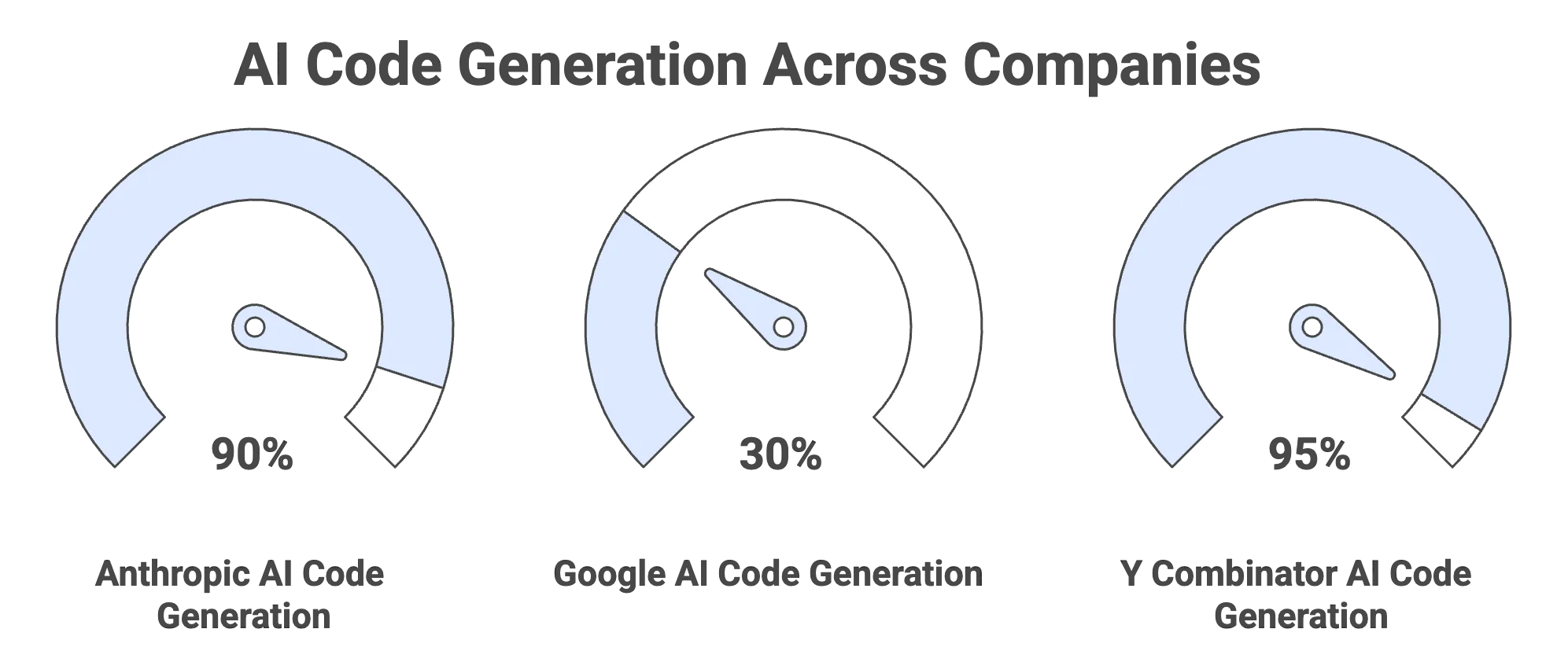
The numbers tell the story. At Anthropic, CEO Dario Amodei confirmed that AI now writes 90% of code for most teams, though he emphasized this means they may need more engineers, not fewer. “If Claude is writing 90% of the code, you need just as many software engineers. They can focus on the 10% that’s the hardest, or supervising a group of AI models. You just end up being 10 times more productive.”
At Google, AI is responsible for over 30% of new code. At Y Combinator, 25% of the Winter 2025 startup batch shipped products with codebases that are 95% AI-generated. As YC CEO Garry Tan noted: “You don’t need a team of 50 or 100 engineers. The capital goes much longer.”
These aren’t prototype statistics. These are production systems at scale. And they point to a fundamental restructuring of the relationship between engineering investment and output.
What This Means for LC/NC Migration
Teams locked into LC/NC platforms are now using AI to reconstruct modern, maintainable codebases by working from what they already have: application screenshots, product requirements, design documents, and behavioral specifications extracted from running systems.
This isn’t line-by-line translation. It’s behavioral reconstruction, treating legacy systems not as codebases to be manually ported, but as behavioral systems whose specifications can be extracted, validated, and used to generate new implementations.
For the CFO tracking engineering headcount against output, this is the unlock. Migration timelines compressed by 40-60%. Engineering capacity preserved for innovation rather than archaeology. Capital deployed toward growth instead of maintenance. The ROI calculation that once made migration prohibitive has been inverted.
The Framework: Spec-Driven Development for Brownfield Systems
The broader industry has recognized that vibe coding alone isn’t sufficient for serious engineering. Spec-Driven Development, the practice of using structured specifications to guide AI coding agents, has emerged as one of the most significant methodological shifts of 2025. Tools like GitHub’s Spec Kit have demonstrated how specifications can serve as contracts between human intent and AI execution, while practitioners have documented both the power and the pitfalls of these approaches in complex codebases.
But most SDD implementations focus on greenfield development: new features, new systems, new codebases. The harder problem, and the one most relevant to LC/NC migration, is brownfield modernization, where you’re not starting from a blank slate but from a running system whose specifications were never formally captured.
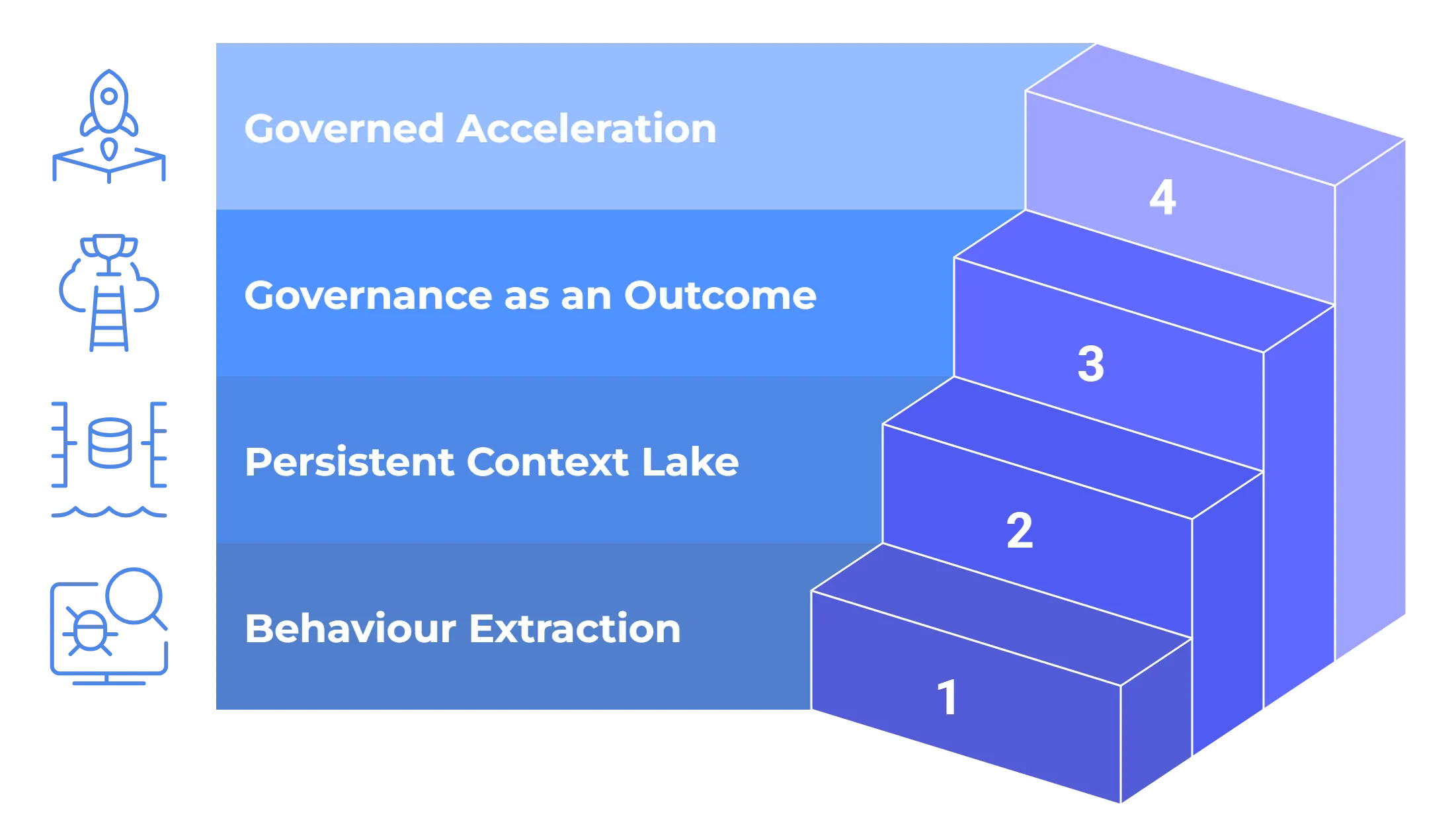
This is where our approach diverges. Indexnine’s implementation of Spec-Driven Development (SDD) is built specifically for brownfield environments, with three key differentiators.
First, behavioral extraction as the starting point. Rather than requiring teams to author specifications from scratch, we extract behavioral specifications from running systems, capturing what the software actually does, not what documentation says it should do. This addresses what practitioners have identified as a core challenge: in legacy modernization, the original intent is often lost to time.
Second, a persistent Context Lake. Most SDD tools treat specifications as project-scoped artifacts. Our Context Lake is an organizational asset, a continuously updated repository of specifications, code, architectural decisions, and project artifacts that persists across projects and teams. It serves as a living context delivery engine, ensuring that every AI agent operates with full, current organizational knowledge. Unlike session-scoped context windows, the Context Lake accumulates institutional memory and makes it accessible to any agent in the development lifecycle, whether code generation, testing, DevOps, or documentation.
Third, governance as an outcome, not a layer. Many organizations attempt to bolt governance onto AI-assisted development as a separate process. In our implementation, governance evidence emerges naturally from how work is done. Traceability between specifications, generated code, tests, and documentation is inherent to the workflow, not added after the fact. For regulated industries and enterprise clients, this means audit trails without additional process overhead.
The result is governed acceleration: speed without sacrificing consistency, and AI-assisted development that remains aligned with product intent from discovery through delivery. Teams using this approach are executing at three to five times their previous pace.
From Framework to Platform: Indexnine Snap™
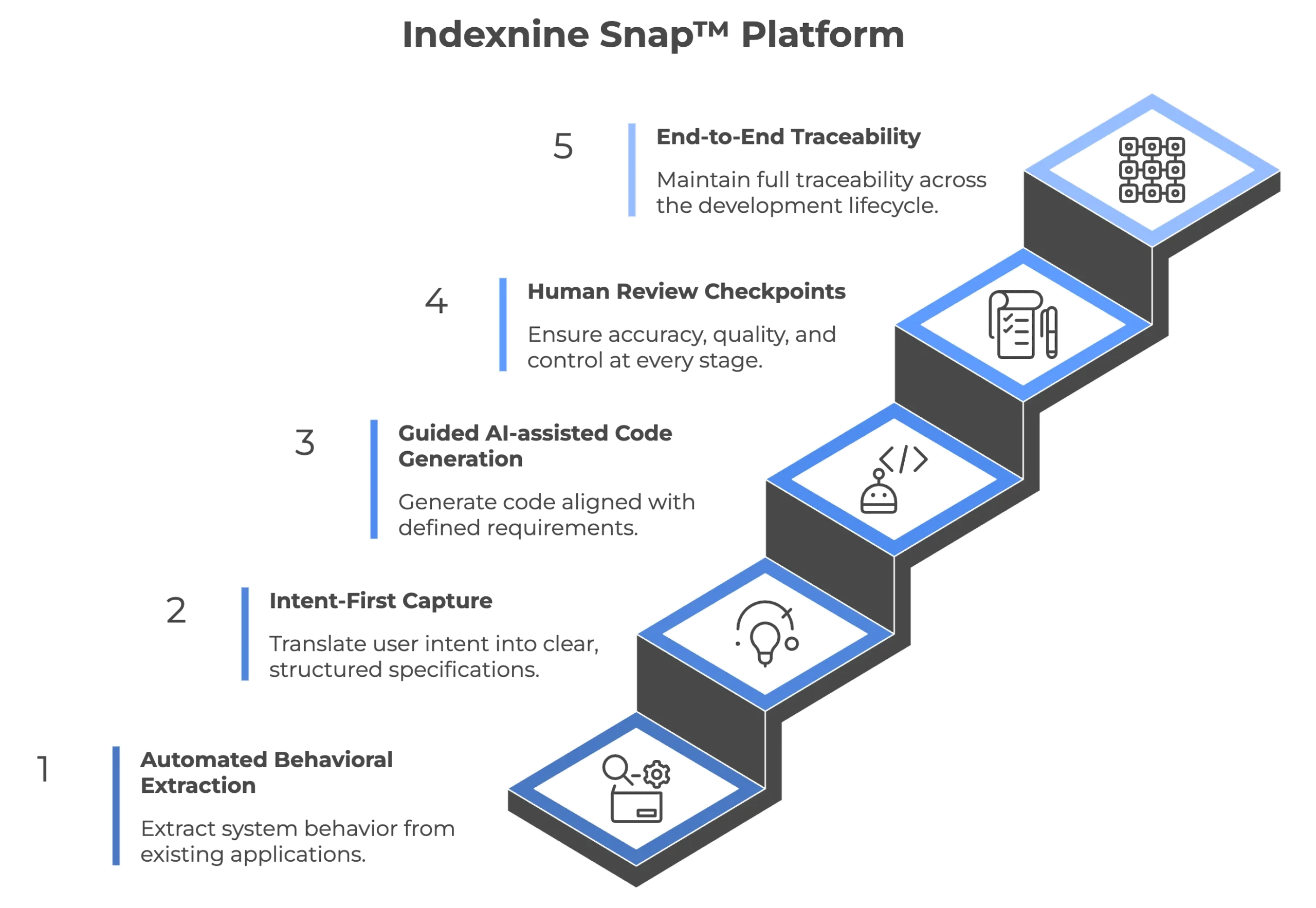
Indexnine’s Snap™ platform operationalizes these principles. It sits between understanding a system and implementing change, ensuring that work is clearly defined, reviewed, and bounded before AI-assisted development accelerates execution. This matters especially in brownfield environments, where undefined scope is usually the first thing that derails a migration.
For organizations migrating off LC/NC platforms, Indexnine Snap™ provides
- Automated behavioral extraction
- Intent-first specification capture
- Guided AI-assisted code generation
- Human review checkpoints
- Full traceability across the development lifecycle
For leadership teams evaluating engineering investments, this means predictable delivery, demonstrable quality, and evidence that travels with the code.
Making Modernization Rational
The real question isn’t whether your LC/NC platform will eventually need to be replaced. It will. The question is whether you can modernize on your own timeline, while maintaining product velocity, or whether you’ll be forced into it by circumstances outside your control.
The platforms that once promised to free you from complexity have become their own form of lock-in. But the tools to break free now exist, and the economics have shifted decisively in favor of action.
Indexnine Snap™ platform enables governed, accelerated modernization through automated behavioral analysis and spec-driven regeneration. We help engineering teams modernize critical systems without sacrificing product velocity, turning essential architectural work into a strategic advantage.
What Comes Next
This is only one part of a larger shift. In the next articles, we’ll go deeper into the forces shaping this transition. From escalating licensing costs and limited extensibility to the growing gap between low-code platforms and AI-native development.
We will also explore how organizations can navigate each of these without slowing down product velocity.