Not Every AI Engineering Company Is Solving the Same Problem
From IT Services to AI-Native Engineering: how the industry is changing
- Ankit Choudhary
- July 7, 2026

Every IT services company today says it’s an AI company.
Every digital engineering company says it’s doing AI Engineering.
When we look closely, most of them aren’t solving the same problem. Calling all of it “AI” hides more than it reveals and it’s worth being precise about why, because it’s the same question we had to answer for ourselves before we built our own practice.
We think the industry is being measured with the wrong yardstick
Ask most buyers how they compare engineering partners and you’ll hear: revenue, headcount, geography, service catalog. Those numbers tell you about scale. They don’t explain why two similarly sized companies feel like genuinely different partners to work with, or why a newer, smaller firm might be the right fit for one kind of problem and the wrong fit for another.
Revenue and headcount tell you about the past. Here’s the lens we’ve come to use instead: what is this company actually optimized for?
That question maps onto three generations of engineering companies, roughly in the order each one became the industry’s default. Most companies fit cleanly into one. A few (including us) sit across two which turns out to say something useful in itself.
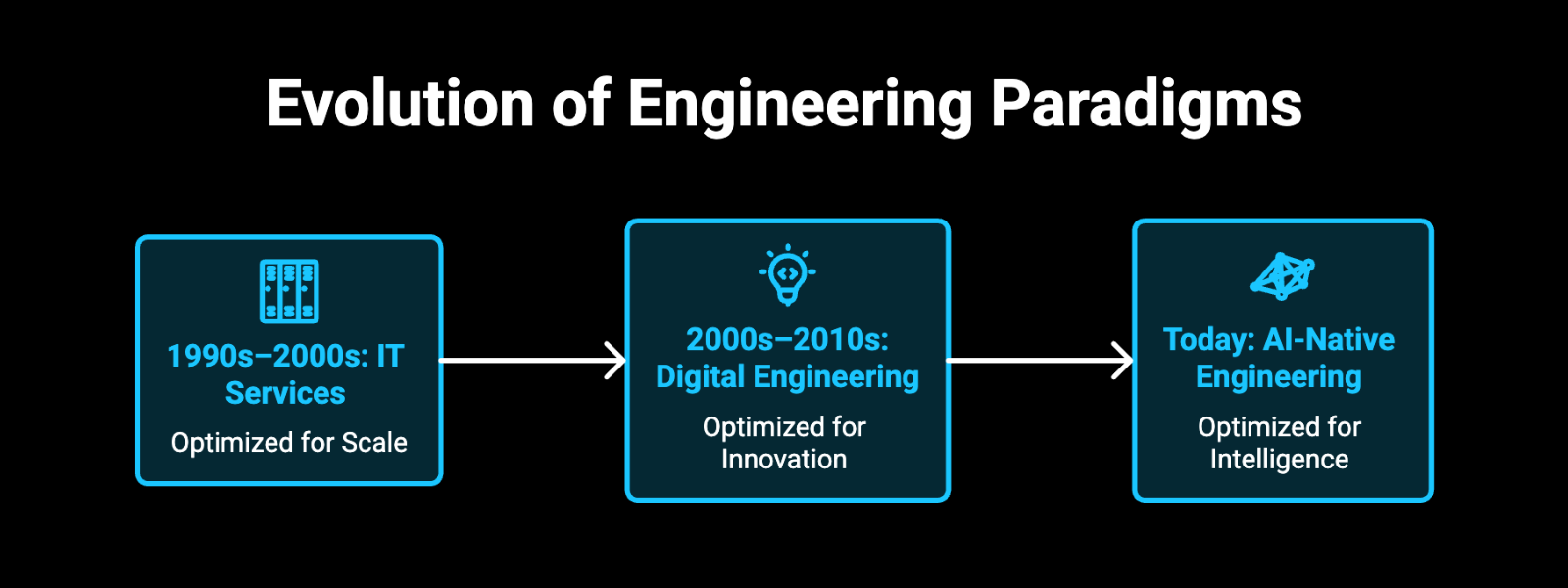
Generation 1- IT Services: optimized for scale
In the 80s and 90s, the job was simple to state and hard to do well: take a spec, staff a team, deliver reliably and at a price that scales. TCS, Infosys, and Wipro built enterprise delivery machines around exactly this, and decades later they’re still extraordinarily good at it. This isn’t a story about them being wrong.
It’s also true that a delivery process refined over decades is, by design, slow to change. That’s why “adding AI” inside these organizations tends to look like a new tool bolted onto an existing pipeline, rather than a redesigned pipeline.
Generation 2- Digital Engineering: optimized for innovation
In the 2000s and 2010s, software stopped being a back-office function and became the product. That’s the real answer to “what is Digital Engineering”: engineering that has to absorb UX, cloud, platform, and DevOps into one discipline. EPAM, Globant, Nagarro, and Persistent are the digital engineering companies that built their identities here, taking the industry from “build software” to “build digital businesses.”
This is also where most of today’s “AI Engineering” claims are genuinely happening, and it’s a real step up from staff augmentation: AI layered into an already-sophisticated digital engineering practice.
It’s also where a good part of our own work actually lives. A lot of what organizations need right now isn’t a rebuilt SDLC. It’s an honest read on where they stand on AI readiness, and a roadmap for getting from where they are to where they want to be, without stalling delivery to do it. That’s a consulting-shaped problem, not a purely engineering one, and it’s a real part of what we do, alongside the engineering-led work described below.
Generation 3- AI-Native Engineering: optimized for intelligence
This is where most self-described AI engineering companies actually sit today; the newest, thinnest category, and the one most loosely claimed by companies that haven’t built it.
“We use GitHub Copilot” is true for a lot of companies. It isn’t evidence of AI-native engineering. AI-native means AI participates across the lifecycle, not just at the point of writing code: from how a spec gets written, to how it gets built, tested, reviewed, and governed, to how the system retains what it learned for next time.
We’re one of a small number of companies that have organized part of our practice around AI native development rather than only adding AI to an existing one, reorganizing how our engineering system works so AI participates throughout the lifecycle, not just during implementation.
We’re not claiming to have arrived at some final state, and we don’t think anyone has. What we’d say instead is: we’re not asking clients to trust a finished answer. We’re building the answer alongside them, which is a different and more honest position than claiming to already be there. Plenty of others, from AI-native coding startups to internal efforts inside the larger firms above, are exploring versions of the same idea, and it’s too early to say any one approach is right for every situation. A large, low-ambiguity modernization program may still be better served by a company optimized for scale and proven delivery, not one still building its answer.
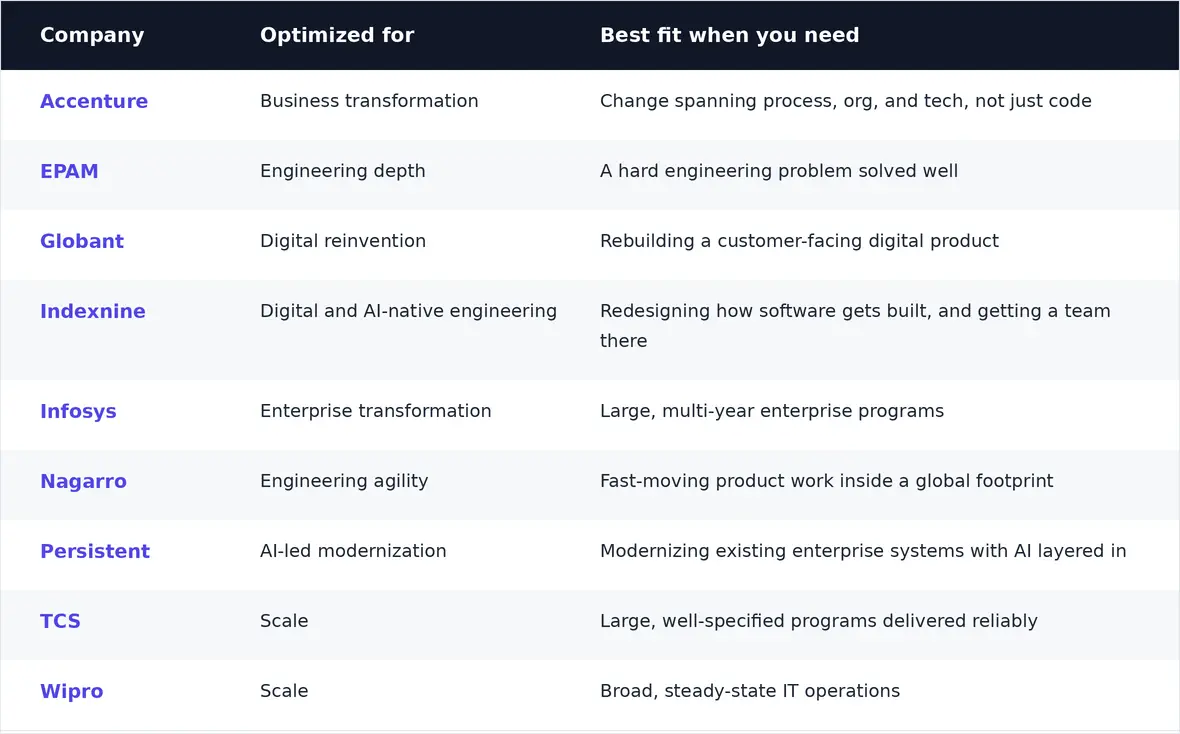
The map, in one table
Every row here comes with the same trade-off, including ours: what made a company excellent for the previous era isn’t automatically an advantage for this one, and what a newer company lacks in track record, it also lacks in inertia.
What happens to “a team” when AI is a participant, not a tool
If AI can write code, generate tests, review pull requests, and draft architecture; what exactly are engineers doing?
We think the honest answer is that the work shifts. From writing software to designing systems. From managing people to orchestrating AI. From shipping a project to owning an outcome.
That shift is real, but it isn’t free. Spec-driven, AI-native workflows ask engineers to work differently than most of them were trained to: writing specs an AI can execute against, reviewing AI-generated code and tests critically instead of writing everything by hand, knowing when to trust an agent’s output and when not to. Most engineering organizations don’t have that muscle yet, and building it while still shipping is genuinely hard. Part of how we’ve approached this with clients is augmentation rather than a training program in isolation: domain-trained, AI-native engineers working inside a client’s team, extending capacity while the client’s own engineers build the new muscle on real work rather than in a workshop.
A traditional delivery team might be 100 developers. An AI-native team looks more like a smaller core of engineers, a fleet of AI agents handling a meaningful share of implementation, a review layer, a couple of people orchestrating handoffs between agents and humans, and a few platform engineers keeping the system reliable. The need for judgment doesn’t shrink. It moves to different points in the process, and to different people.
That also changes what’s actually being sold, not just how work gets done. IT Services sold developers. Digital Engineering sold teams and outcomes. What we’re building sells something closer to capacity engineers and AI agents extending each other, not a headcount number.
A few questions worth asking, once you see it this way
You don’t need a new vendor evaluation process to use this lens; just a few different questions in the same conversations you’re already having:
- How much of your SDLC actually involves AI beyond writing code (specs, testing, review, architecture) versus just autocomplete at the point of implementation?
- What happens to your delivery process if the AI tooling gets switched off tomorrow? If the answer is “nothing changes,” that’s a tell.
- Who’s accountable when an AI-generated component fails in production, and what does that review process actually look like?
- Is your team retraining engineers into this way of working, or just adding AI tools on top of how people already work?
None of these questions has a universally right answer, a company optimized for scale should probably answer them differently than one optimized for AI-native delivery. But the answers will tell you a lot more about who you’re actually hiring than a services catalog will.
The line worth remembering
Most of the companies in the table above are still deciding whether to redesign their engineering model around AI, or keep adding AI to a model built before AI existed. We’re in the middle of that transition ourselves, on purpose, and a lot of what we do is helping other organizations make the same move.
If you’re evaluating engineering partners over the next few years, that’s probably the more useful question to ask is not who has the biggest delivery organization, but what their engineering system is actually optimized for. Revenue and headcount tell you about the past. What a company is optimized for tells you what happens after you hire them.